Ancillary Justice

eBook, 393 pages

Published July 29, 2013 by Orbit.

View on OpenLibrary

5 stars (8 reviews)

Sequels: Ancillary Sword; Ancillary Mercy.

20 editions

Great world building

5 stars

The world building is great. Tons of interesting ideas, including the »ancillaries« from the title.

The name »the Raj« sorry, »Imperial Radch« was a bit on the nose, tho. Let’s see * an empire * bent on conquest * living on goods gotten from the conquered realms * with the ruler (she/her) basically living forever * the are the only true civilization. You are either part of it or you are nobody * they drink tea

OK. A mix of the British Raj and China. The Aptitudes is more like the imperial examination/科舉.

Really enjoyed this one

4 stars

This one took a bit of warming up to, the perspective of the main character/narrator was a bit hard to follow at first, but once I saw what was going on it became easier. Definitely a page turner. I enjoyed the novel perspective, and found myself quite attached to the characters by the end. A friend lent my all 3 of the books in the series, and I can't wait to dig into the next one.

Two sides of a crisis

5 stars

There's so many good bits and little shiny details in this epic redemption journey. In the past, a simple occupation mission by an atrocious all-conquering invasion force goes awry with a mysterious conspiracy coming to a head. The protagonist is an AI ship consciousness multiply embodied in enslaved human soldiers. A crisis builds under the watchful eye of an empress that rules from within thousands of bodies.

In the present, the aftermath of the crisis is our protagonist singly embodied, troubled by the atrocities it committed and dedicated to a hopeless mission of vengeance.

There is a lot of dealing with a... not an untrustworthy narrator but an extremely neurodivergent naive narrator. Lots of fun gender issues and language issues that present as interesting puzzles for the reader.
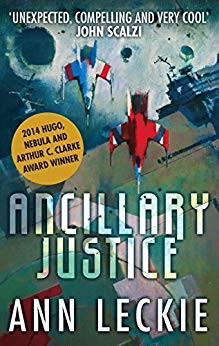

Review of 'Ancillary Justice' on 'Goodreads'

4 stars

J’ai eu du mal à me mettre dedans, les règles grammaticales sur le genre étant non seulement confusante mais désagréable (j’ai eu l’occasion de lire un livre où tout était genré au féminin « elle pleut », « la bébé », mais ce n’est pas pareil).
Après quelques chapitres (et ayant appris que la version originale était aussi « perturbante » et que ce n’était pas une aberration de traduction), j’ai enfin profité du livre.
Une histoire complexe et très bien ficelée, originale, que j’ai trouvé très rafraîchissante.