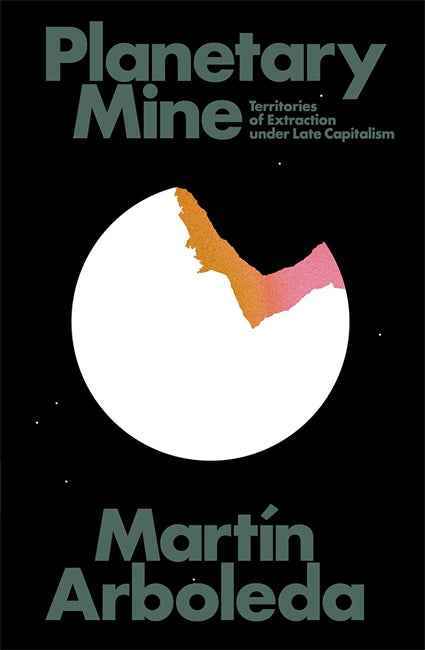

ralentina reviewed Planetary Mine by Martin Arboleda
Planetary mining and an expanded notion of extractivism
4 stars
The book argues that extraction – as a logic, a set of technologies, and of spatialised economic relations, has expanded in ways that defy both national boundaries, and also historical ‘global peripheries’. Key to this expansion are the increasingly globalised nature of the world economy, and the emergence of China as an hegemonic actor outside the West. Each chapter looks at a different dimension of these entanglements, taking Chile as a starting point: 1. Labour: considers how the adoption of cutting-edge technologies in the mining sector have reconfigured the labour force, dividing it into a higher class of well-paid engineers, often operating from a metropolitan centre such as Santiago, and an informal labour market largely made up of racialised labour migrants. This proletariat has more similarities (and shared class interests) with Chinese migrant industrial workers than with the above mentioned engineers – but we are a long way from building …
The book argues that extraction – as a logic, a set of technologies, and of spatialised economic relations, has expanded in ways that defy both national boundaries, and also historical ‘global peripheries’. Key to this expansion are the increasingly globalised nature of the world economy, and the emergence of China as an hegemonic actor outside the West. Each chapter looks at a different dimension of these entanglements, taking Chile as a starting point: 1. Labour: considers how the adoption of cutting-edge technologies in the mining sector have reconfigured the labour force, dividing it into a higher class of well-paid engineers, often operating from a metropolitan centre such as Santiago, and an informal labour market largely made up of racialised labour migrants. This proletariat has more similarities (and shared class interests) with Chinese migrant industrial workers than with the above mentioned engineers – but we are a long way from building that kind of cross-globe worker solidarity. 2. Circulation: considers the logistical systems that support mining. Arboleda notes how the state has used infrastructural development to entice investments in mining. The largest infrastructures are the port, associated with high level of pollution, speculative urban development and displacement. Thus, urban dwellers are also ‘victims’ (my term, not Arboleda’s) of mining extractivism, facing the same repressive apparatus (militarised police) that represses the miners’ strikes. 3. Expertise: looks back at the role of the Chicago Boys in creating the current Chilean economy. It notes how they were able to maintain an aura of rationality and expertise by letting the military doing the dirty work of dispossessing farmers and repressing workers. Similarly international investors are not bothered by the violence of the state as long as ‘the rule of law’ is guaranteed enough to protect their interests. These dynamics, Arboleda argues, were especially obvious in this case but underpin extraction more generally. 4. Money: considers the role of debt in the mining sector, at multiple scales. At the state level, infrastructural development connecting the Pacific Rim has been made possible through sovereign debt. At the regional level, new mining operations are increasingly costly and are financed through investment funds. And finally, at the household level, in areas where urbanisation is driven by mining, the population is forced into debt (via credit cards and store cash cards) by raising living costs. From these perspective, the state, the mine and the people are all ‘disciplined’ by financial capital. 5. Struggle: underscore once more the importance of workers solidarity transcending the core/periphery and rural/urban divisions. Here, Arboleda draws on Latin American literature that has explored the tensions between socialism and indigenous movements, arguing that they are NOT incompatible. Global solidarity requires a ‘universalism of difference’ that rejects the teleological understanding of progress of certain version of Marxist thought.
The epilogue summarises the book's argument and makes clear extraction is not the only defining logic of contemporary capitalism, and it is still important to look at others, e.g. worker exploitation.